
Crowns and Bridges
We offer highly aesthetic solutions to repair teeth and fill the gaps left by tooth loss including single-visit ceramic crowns and dental bridges.
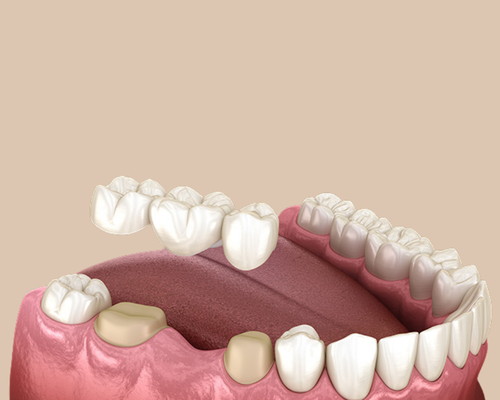
Crowns and Bridges
Crowns and bridges are restorations that correct dental problems while protecting and strengthening your teeth.
A dental crown is custom-made to fit over a damaged natural tooth. It restores the function of the tooth and provides strength and support. Dental bridges are also versatile and have a number of uses.
Crowns and bridges are usually made of porcelain because of its natural appearance and durability.
Everyone wants a smile that is healthy and beautiful, and we can help you reach that goal by using crowns and bridges. Updated techniques and treatments have made the placing of crowns and bridges easier than ever before.
When Are Dental Crowns and Bridges Used?
Dental crowns have many applications and can be used to correct a number of problems:
- Severely decayed teeth
- Teeth weakened by root canal treatment
- Fractured or broken teeth
- Broken fillings
- Large, unattractive fillings
A dental bridge is used to fill the space left by a missing tooth. The bridge is usually made as a single unit that is held in place by crowns on adjacent teeth. A dental bridge not only improves your appearance, but also prevents surrounding teeth from shifting out of place and moving into the space left by a missing tooth.
At your child’s first visit, we will help familiarize them with our dental office so they feel completely comfortable. We will show them their teeth in the mirror, take them for a ride in the chair, and brush their teeth. That way, when it is time for their dental cleanings and other regular care to start, everything is familiar.
What Does Placing a Crown or Bridge Involve?
A dental crown or bridge can usually be placed in two or three visits. First, we prepare your natural tooth to receive the restoration and then impressions are taken of your teeth. The impression accurately represents the position of your natural teeth so that your restoration fits perfectly.
The impressions are sent to a special dental lab, where they are used to create your permanent restoration, which usually takes about two weeks. Before you leave our office, we fit you with a temporary bridge or crown that you wear while the new crown or bridge is being prepared.
Once the restoration is finished, we will schedule an appointment for you to return to our office. At that time we check the finished restoration for proper fit, making adjustments as necessary. Finally, the restoration is cemented permanently into place.
Before you leave our office, we will give you instructions on caring for your new restoration. The restoration is fully functional, but you should remember that it requires special care to prevent damage and the need for replacement. If you practice proper oral hygiene and schedule regular dental cleanings, your new restoration will last for many years.
Call to Schedule an Evaluation
Are you troubled by a damaged or missing tooth? Please call our office today to schedule an evaluation and learn more about your options!
Frequently Asked Questions
When and why do I need a crown? What is a
A crown (or “cap”) is usually needed when there is no longer sufficient healthy tooth structure left to retain a simple filling. Teeth that have had root canals need crowns to strengthen them. After root canals teeth become more susceptible to fracture if not protected with a crown. A growing trend in dentistry is to replace missing teeth with an implant. The implant is like a screw that goes into your bone (sort of like the root of your tooth did before) and is the foundation for which a crown will be placed. The crown is the portion of tooth above your gums and the implant or root is the portion of the tooth below your gums that anchors into the bone.
A “post” is most commonly needed for front teeth for which there has been a break in the tooth that is level with, or nearly level to, the gums. As you can imagine, this makes it very difficult to anchor enough restorative material above the gums to make a crown around. With these teeth, we will typically let an Endodontist prepare the root canal space for a root canal and post. After your treatment with the Endodontist, you will be referred back to our office and they will give you the post to bring back to us. And Endodontist is a specialist that has additional training in specifically doing root canal procedures.
At your crown preparation appointment, we will begin by cementing this post into the root canal space. This will give us something that sticks up to hold our restorative material onto. After this we have enough substance to anchor our “buildup” onto. The buildup is the foundation to which a crown can be anchored to when there is not enough natural tooth left. Most of the time, on back teeth, we can just do a buildup if there is a significant amount of tooth structure missing, unless the break encompasses the entire tooth at or near the gumline. This has a lot to do with the direction of force being put onto the back teeth versus the front teeth. Front teeth have more of a shearing force (back to front) force being put on them than do back teeth. Back teeth are more under a compressive type force (straight down towards the root of the tooth when biting).
Dr. Scott Jackson
Dr. Jackson was raised in a small town outside of Jackson, Mississippi (Florence, MS). He always knew he wanted to serve in some way, and after high school, he decided to join the U.S. Navy soon after September 11, 2001. He served onboard the USS Jacksonville (SSN 699), which is a “fast-attack” submarine. Dr. Jackson was stationed in many different areas, including Norfolk, Virginia; Great Lakes, Illinois; and Kittery, Maine.
After his service in the military, Dr. Jackson wanted to continue serving while pursuing his childhood dream…
Eat the foods you love and smile with confidence
We reserve time for new patients to get started